Bandha and Mukti: from a philosophical idea to the practice of Yoga
1. The philosophical ideas: Bandha and Mukti
- In Hindu philosophy: Bandha (बंध) means « attachment to the world » through the chaining together of our actions (karma). It is the direct opposite of mukti (मुक्ति), Sanskrit for « liberation », « final deliverance » or « salvation ».
- In Jain philosophy: the view of bandha is close to the Hindu one. Here it stands for the attachment and the binding of karma to the soul (jīva). Bandha is one of the nine tattva (तत्त्व) — the essential principles, or truths, that lead a human being towards awakening (mokṣa). To free oneself from karma and reach that deliverance, the seeker must cultivate the Three Jewels together: right vision, right knowledge and right conduct.
2. Bandha in Yoga and in Sāṃkhya
In the philosophies of Yoga and Sāṃkhya, the word takes on a technical meaning, at once postural and energetic. From the Sanskrit root meaning « to bind », « to connect », « to hold », « to close » or « to control », bandha names the act of joining and connecting. In practice it is a bodily and energetic lock that channels the breath (prāṇa).
The three main locks (Bandha)
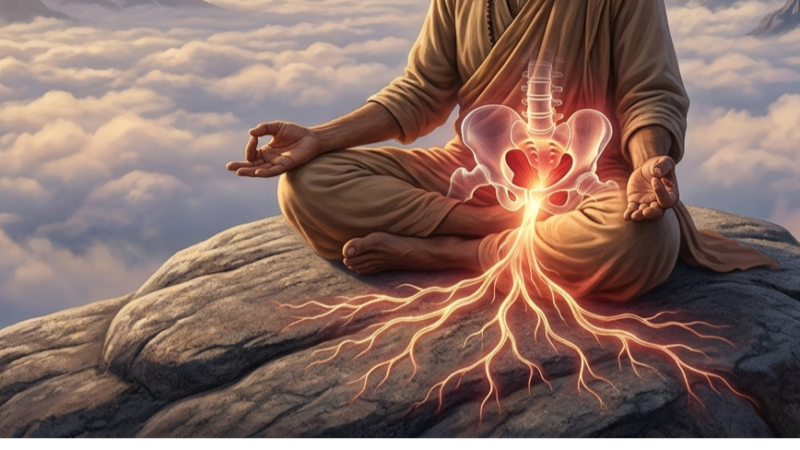
- Mūla Bandha (the root lock): a reflexive, conscious lifting of the muscles of the pelvic floor (the perineum). It roots and steadies the energy.
- Uḍḍīyana Bandha (the abdominal lock): the belly is drawn up and in, beneath the ribcage. It is performed on a retention with the lungs empty (bāhya kumbhaka).
- Jālandhara Bandha (the throat lock): the head tips forward and the chin lowers towards the chest. It seals the energy at the throat and is held either with full or with empty lungs, suspending all breathing in or out.
- Mahā Bandha (the great lock): the three locks above combined and applied together.
The paradox of « bandha »
To understand how the act of « binding » can free one from karma, the idea has to be looked at from two complementary angles: the mechanism of the practice (the technique) and the aim being sought (the metaphysics).
1. Channelling energy rather than scattering it
In everyday life our mind and our energy (prāṇa) are scattered by our desires, our fears and our automatic reactions. That scattering creates further reactive action — karma.
- Binding in order to master: by applying a bandha — a physical and energetic lock — the yogi closes the doors through which energy escapes.
- The image of the river: it is the principle of a dam. By holding and binding the water (the energy), an immense force is created. Instead of leaking outwards and feeding our worldly attachments, the energy is turned inwards.
Karma accumulates because we are slaves to our mental and physical conditioning (saṃskāra).
- Breaking the cycle: the bandhas act as a ligature on the physical plane, obliging the energy to rise through the central channel (suṣumṇā).
- Dissolution: once the energy is locked and gathered in this way, it rises towards the higher centres (the chakras) and burns the seeds of unconscious karma. By binding the body consciously, one stops being bound unconsciously by one’s habits.
In Indian philosophy, complete freedom (mokṣa) is not reached through unruly freedom but through rigorous discipline.
- The « good » bond: the word bandha then shifts from meaning « a chain one undergoes » (the cycle of saṃsāra) to meaning « a commitment one chooses ».
- Binding oneself to the practice: a temporary, conscious bond (the technique of bandha) is used to break the endless, unconscious ones (karma). Once liberation is reached, the physical bandha has no further purpose: the container gives way to what it held.
In short, the body and the breath are bound so that the mind may stop binding itself to the world. It is a counter-fire: the principle of the bond is used to destroy the very nature of attachment.
A technical note: the technique of Uḍḍīyana Bandha (which requires a retention with empty lungs) should not be confused with the engagement of Uḍḍīyana in the practice of Aṣṭāṅga Yoga. In the latter it is held continuously alongside Mūla Bandha, while the breath keeps flowing freely in the chest.