
Ujjāyī Prāṇāyāma is the reference breath of the postural practice of Ashtanga Yoga. It accompanies every movement, sets the rhythm of the Vinyāsa and lets the practitioner stay present from the first posture to the last. Its soft sound, often compared to the breath of the ocean, guides the attention without scattering it.
The breath in the postural sādhanā
Throughout the postural “sādhanā” of Ashtanga Yoga we use a breath called “Ujjāyī Prāṇāyāma”, “the breath of the ocean”. There are many variations of the ujjāyī. The breath (prāṇāyāma) is always synchronised with the movements. For a beginner, the inhale and the exhale should be of equal length; for an advanced practitioner, the inhale is a little longer.
The breathing methodology of Ashtanga Yoga
- a continuous, uninterrupted flow;
- always breathing through the nose;
- gently opening the region of the larynx (Jālandhara);
- which should produce a soft sound (ujjāyī).
The sound of the breath (ujjāyī) is thus obtained through the positioning of the throat (Jālandhara). Jālandhara is the control of the glottis in the ujjāyī breath: the positioning of the two lateral thyroarytenoid muscles that produces the characteristic ujjāyī sound. The specificity of the ujjāyī lies in the “control” — a partial opening of the glottis — meant to slow both the air coming in and the air going out.
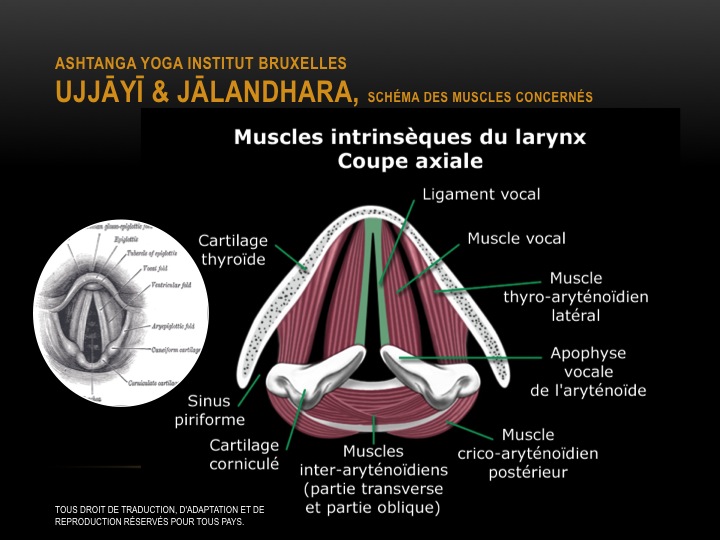
Note: it should not be confused with the held breath (Jālandhara bandha).
A continuous breath for a continuous practice
In Ashtanga Yoga, Ujjāyī Prāṇāyāma is not added to the practice: it forms its very weave. When the breath stays continuous, the movement becomes more legible. The practitioner can feel whether they are speeding up, forcing, or losing focus — the breath becomes a very concrete guide. The sound should stay soft. If it turns harsh, too loud or uneven, it often signals excess effort; if it grows too faint, it may indicate scattered attention. The balance is found in a breath that is audible to oneself, steady, even, and tied to the rhythm of the body.
Conclusion
Ujjāyī Prāṇāyāma supports the Vinyāsa, gathers the attention and gives the practice its continuity. By listening to it, the practitioner learns to move with more precision and calm.