This “News Letter” No.9, was written in December 2011 in Mahābalipuram – South India
From Darkness to Light, or from pain to sweetness,
the way of the Yoga road towards plenitude…
Par Jean Claude Garnier
Letter to whom needs it, when everything goes wrong …
Here are some tricks that help me personally to navigate in troubled water. In the first place, I try to think of a belief that is not necessarily real but can be very useful; it is the following one:
“If a situation happens, what ever it be, it must be to my advantage.” It is not always easy to lean on this belief, but the simple fact of thinking about this idea allows us, for a few moments, to change our point of view and to find our energy.
Another question than you can ask yourself is the following one:
“Which is lesson of life that I have to get from it?”
You can also adopt a different point of view by telling yourself:
” Well! Things are not going well. I have fallen down in my life. What happened exactly?
What must I learn to make sure that a similar situation does not occur again in the future?”….
When everything goes wrong, we lose our guidelines and we sometimes fall into a vicious circle, what I call the negative moment. The negative moment is when we feel worse and worse, and can only concentrate on the negative. The best way of coming out of the negative is to remember the following truth: our two guidelines are the ”Now (the present moment) and our emotions”.
If you use the two variables that I have just mentioned, as a guide,you will always manage to find yourself.
At this moment, what can I do to feel just a little bit better? I am not thinking here, of jumping from a state of total despair to a state of passion and absolute confidence. I am just looking for the concrete things that I can do at this moment to feel just a little bit better. In the background, there are only two stable variables in our lives: the present moment and our feelings. If you use other criteria to guide yourself, you have high probability of regrettably falling into the negative moment …
I also advise you to ensure that your energies are balanced. You can use any technique, be it walking, reiki, a massage, singing, playing an instrument, painting, etc.
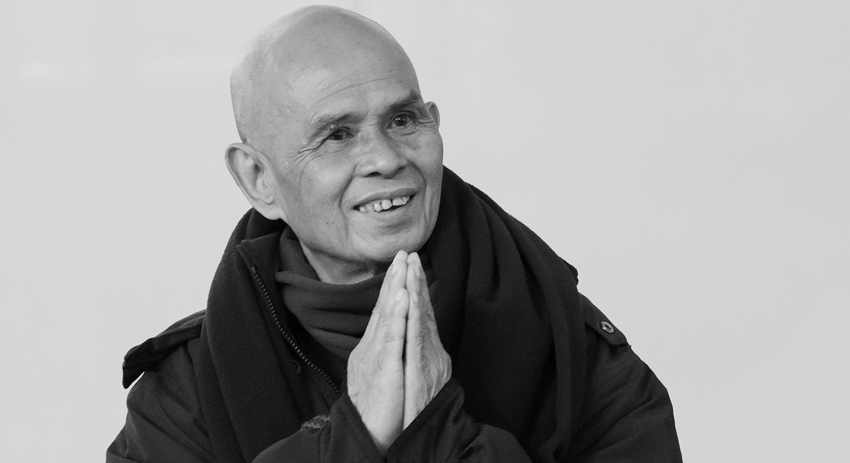
As says Thich Nhât Hanh in his book on ” Anger “: do not let yourself be destroyed by it, use this wonderful strength to go further …
Yoga, as many other disciplines, requires finding your second breath… When you are lucky enough to touch your limit, it is the limit of the first breath? In order to find your second breath you have to give yourself up to the divine law … Isvara pranidhana – YS II, 1.
When you suffer and cry on your mat, be delighted … because, as magnificently said by Mother Theresa :
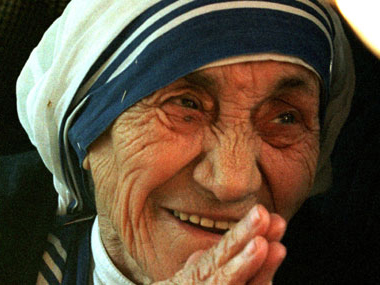
” When we approach the pain and accept it; the pain leads to LOVE ”
Mother Theresa
And Arnaud to say:
” You are afraid of living because to live it is to take the risk of suffering ”
Arnaud Desjardins (in ” The boldness to live »)
YES, INDEED at this moment I make every effort so that you continue … Page 2
It is an illusion to believe that we can move forward in sweetness …
The Buddha declared that the major reason that keeps human beings in the saṃsāra (सðसार) and prevent them from awaking, is that they do not completely understand Duḥkha (Dīgha Nikāya, 16, 2, 1).
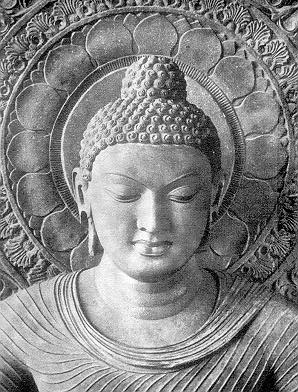
Presentation of the first noble truth of the Buddha
” Well, o monks, the noble truth of Duḥkha : the birth is Duḥkha, to age is Duḥkha, the disease is Of? K Duḥkha , the death is Duḥkha , the sorrow and the lamentations, the pain, the affliction and the despair are Duḥkha, be united with what we do not like is Duḥkha, be separated from what we like or of what pleases what is dukkha, not to obtain for what we wish is Duḥkha. In brief, five aggregates of the attachment are Duhkha “.
It is a good teacher’s duty to tell to a student that he is wrong; that he is going round in circles or that he is going to sleep, to wake him up etc. …
Incorrect practice of yoga is dangerous, not only for the body, but also for the mind. The idea is not to strengthen the defences etc.
“The taming of lions, elephants and tigers requires a lot of time and caution, in the same way the prānā (breath) must be mastered slowly and gradually according to the capacity and the physical limits of each. Otherwise it will kill the student. ” (Hayogapradipika, II, 15)
Incorrect practice is useless; it may hurt you, at the muscular, articular, energetic and mental level by strengthening the defences. Sportsmen know it very well, if you play tennis or golf with a bad movement …
It may be better to eat cakes … If we remember the experiments made by professor Henri Laborit, specialist in human behaviour and philosopher, he introduced neuroleptics and also neurosciences to the general public: ” there is no difference between eating cakes, taking medicine, practising yoga or zazen, if we do it to escape from our anguish … ”
We are not going to reach the state of ” Sthira sukham ā sanam -YS II-46 “, beautifully translated by Gérard Blitz by ” the posture must be firm and pleasant “, effortless, without discomfort, or pain… it is like thinking that we can reach a total transformation of ourself without doing anything, effortlessly, without hard work… don’t confuse the state of arrival with the departure and the road …
The departure is difficult, it is to accept what we ARE … Accept our asymmetries, postural imbalances, our neuromuscular dysfunctions, accept our very often unconscious tensions and our disharmonious breath, and accept the psychic contents of our tensions.
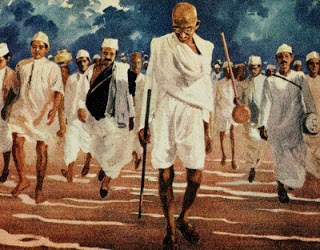
” The ahimsa is not compatible with the fear …
I see how I can successfully preach the ahimsa to those who know
how to die, but not to those who are afraid of death ”
Gandhi (āshram letter, pp. 139/142).
As so well expressed by Satprem in the title of one of its books ” Son of the Sky by the body of the Earth “, it is through the body of the earth, the body of chair, the dense body (sthūla-śarīra), that we go through the practice of Yoga, to awaken the body of light, the body of energy (prānāmāya-kośa), this symbolic body (linga śarīra).
But in this subtle body (sūkshma-śarīra), there are also blockages, painful barriers, accumulations and discharges of energy …
How do we reach this state of eternal and perfect bliss which Indians call Mokṣa (मो&) the delivery, or for the Buddhists the Nirvāṇa (fनवqण ) and what our Tibetan friends call myan-ngan ʼdas-pa (pass beyond the suffering).
YOGA is one of ways. Yoga is nor an activity of leisure, nor of wellness, but a way of psycho-energetic transformation, a method of psycho-corporal integration.
What Yoga offers is to discipline the human “vehicle” in its different aspects: perceptions and actions through sensoriality and corporeality, feelings and thoughts through the mind and the intelligence. Yoga is a discipline and a discipline is a space of freedom, a frame of freedom. Yet, we often think the opposite: how can a discipline and constraints free me?
In the Bhagavad Gītā, Kṛṣṇa, कð ण teaches to Arjuna:
The yoguin staring at his visual energy between both eyebrows, equalizing the inspirations and the expirations which flow inside the nose, master of its sensitive faculties, his mental and intellectual faculties, the Wise person tensed towards release, his ultimate end, is free form desire, fear and anger; he is released for ever. ”
Bhagavad Gita, V, 22/28
The Yoga path is from pain to sweet …
The frame of Yoga is very well defined (read Yoga Sutra). The follower must learn to observe, to feel without complacency or remonstrance, to search for the state of transparency with oneself. Be true with oneself.
If we choose a discipline, a frame, it is important to give oneself the means of this discipline, to respect it, to respect oneself in our choice, that is self-respect, transparency it is not passivity … Only discipline will develop a strength of more and more endurance, that is going to allow us, when we meet difficulties (tiredness, disease, doubt, fear etc.), to continue our path …

And as “Le Petit Prince” said :
We see well only with the heart,
the main part is invisible for eyes.
Antoine de Saint Exupéry
Om Shanti, Peace, Strength and deep Joy
Jean Claude Garnier