This “News Letter” No. 12, was written in December 2013 to Mahābalipuram – South of the India
Yoga and body…
Many problems come from the fact that we identify with the body…
In all times, but more and more in our modern era, human beings identify with their bodies at least with it’s appearance. Body care is a business that pays big: fashion, cosmetics, cosmetic surgery etc.
The individual has become his reflection in the mirror; It is as if this external image we see of our body expressed our individuality and that it is therefore necessary to shape the most admirable image of this representation of self in our body.
Unfortunately, the same has become true for some people in a pseudo-practice of Yoga, from which the narcissistic gymnastics myth of the most perfect, the most beautiful posture.
But can I reduce myself and identify with the image of my body?
“Am I my body?” : paradoxical question on my part, because I introduce with the possessive ‘my’ a distance between ‘me’ and my body. The ambiguity is deep. Can this body be ‘subject’, and have the status of ‘I ‘?
Saying “I am my body”, is assuming an immediate identity of the body to the status of “subject”. To be the ‘subject’ is placing oneself at the origin of the action. It is a subject body. In the Indian philosophy of Yoga, the subject is the observer; he “captures” himself in his globality as a genesis for his actions.
Lanza del Vasto, truth-seeker and friend, first Christian disciple of Gandhi, expressed on this subject :
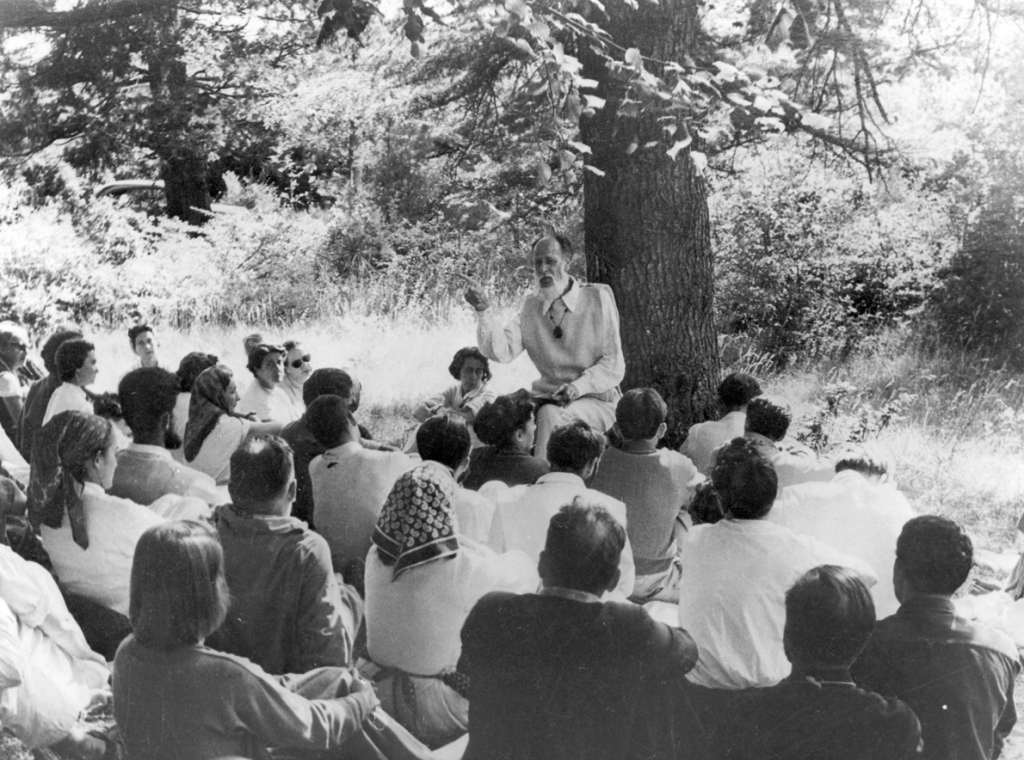
“I am the living unity of all the elements that compose me, I am none of the elements which compose me… “.
Lanza del Vasto
When I practice Yoga postures, my body schema is not the same as when I drive a car. However, as long as it gives me a consciousness of being, it is my opening to the world, this body schema contains also a great deal of anonymity.
It is “the simultaneous contact of my being with the being of the world”. Merleau-Ponty also defines the body as the “natural me” (what Husserl called the soul) in so far as it is through which perception, operates. The ‘I’ or the ‘spectator’, is only present through the materiality of the body. For C. G. Jung, it is this ‘domestic partner’ made up of ‘anima’ and ‘animus’ that makes us a whole human being, it is free and independently administered but to be completely achieved, one must be able to admit and let this unknown part of oneself express itself.
“When you are the observer of your mind, you release your consciousness from the forms of the mind and it becomes what is called the observer or witness. Therefore, the witness – pure consciousness beyond any form – is getting stronger and elaborations of the mind become fainter. »
Yogasūtra – योगसूत्र

To illustrate this, let us listen to what Yehudi Menuhin expresses :
« The performing violinist continually reviews the hours, days and weeks preceding a performance, charting the many elements that will release his potential … he knows that when his body is exercised, his blood circulating, his stomach light, his mind clear, the music ringing in his heart, his violin clean and polished, its strings in good order, the bow hair full and evenly spread, then – but only then – he is in command … »
« His stance must be erect yet supple so that like a graceful reed he may weave with the breeze and yet remain aligned from head through spine to feet. He is a living structure stretched between the magnets of sun and earth. Just as only a stretched string can vibrate, so before a violinist’s body vibrates he must feel drawn upward, his head delicately poised on the vertebrae, his diaphragm raising him on a cushion of air, while the working parts of his anatomy – shoulders, hands and fingers – float and balance at different levels ».
“Just as a man embraced by his beloved no longer knows anything about the ‘I’ and the ‘you’, the self embraced by the Omniscient-Self knows nothing anymore about a ‘myself’ inside or a ‘yourself’ outside, because of the “unity’”.
Bṛhadāraṇyaka Upaniṣad – बृहदारण्यक उपनिषद्
Om Shanti,
Jean Claude Garnier