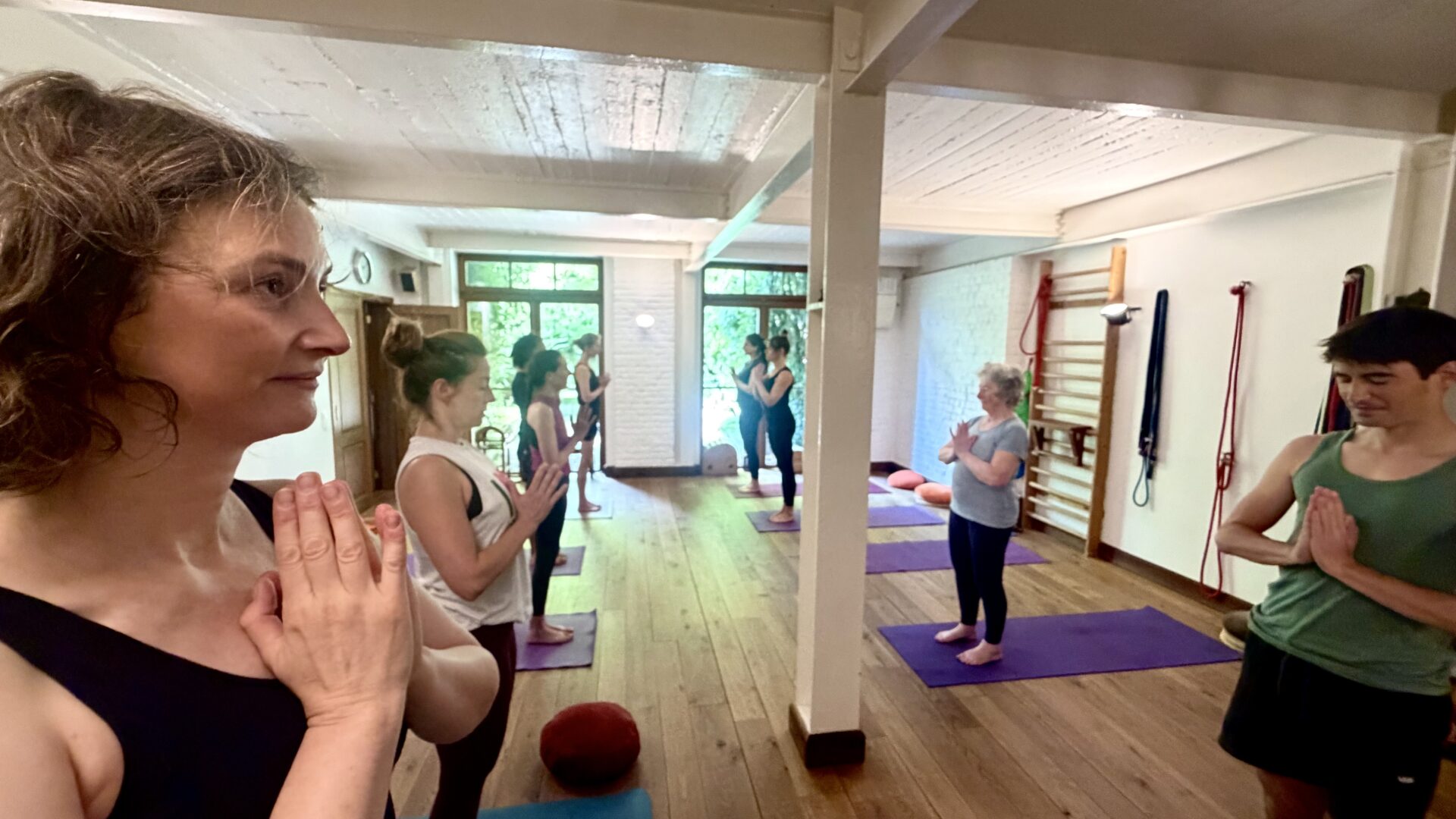
Yoga practice can easily be stripped of its sacred character, or reduced to a mere discipline of well-being or bodily upkeep. When its sacred dimension is forgotten, the very essence of the path of Yoga risks fading away.
This outlook, characteristic of our times, is a veil that obscures the depth of inner experience. By restoring Yoga to its spiritual dimension, it becomes possible to open to subtler states of consciousness, until one recognises the presence of the sacred at the heart of oneself. The opening invocation is not a simple formula recited before practice: it is a moment of passage, of recentring and inner attention. In the teaching of Sri K. Pattabhi Jois, Prārthanā prepares the practitioner to leave ordinary agitation and enter a time devoted to the body, the breath and the mind.
Prārthanā, the opening chant
According to the teaching of Sri K. Pattabhi Jois, this prayer expresses the wish to free oneself from illusion (Māyā) in order to reach supreme knowledge (Satcitānanda). It is recited before every practice of Ashtānga Yoga. It is a moment of change, a rite of passage from profane time to sacred time — a turning of the senses from the outer world towards inner life, to reach the feeling of unity with oneself: “stillness, rest, calm, inner silence” (from the Greek hesychasmos).
“God became man, so that man could become God.”
Athanasius of Alexandria (298–373)
The opening mantra
vande gurūṇāṁ caraṇāravinde
sandarśita svātma sukhāva bodhe
niḥśreyase jaṅgalikāyamāne
saṁsāra hālāhala mohaśāṁtyaiābāhu puruṣākāraṁ
śaṁkhacakrāsi dhāriṇam
sahasra śirasaṁ śvetaṁ
praṇamāmi patañjalimॐ
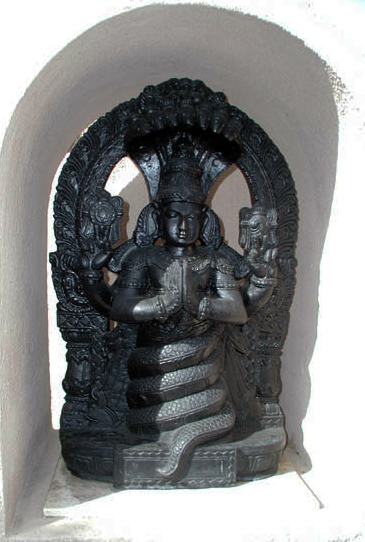
Translation (from Jean-Claude Garnier’s French): Om. I bow to the lotus feet of the Supreme Guru, who teaches the Knowledge and awakens the great happiness of self-revelation. He acts as the physician of the jungle, able to dispel the illusions and the poison of a conditioned existence. Before Patañjali — incarnation of Ādiśeṣa, of white colour, with a thousand radiant heads, human in form down to the waist, holding the sword of discrimination, the wheel of fire of eternity and the conch of the divine sound — I bow. Om.
The closing chant
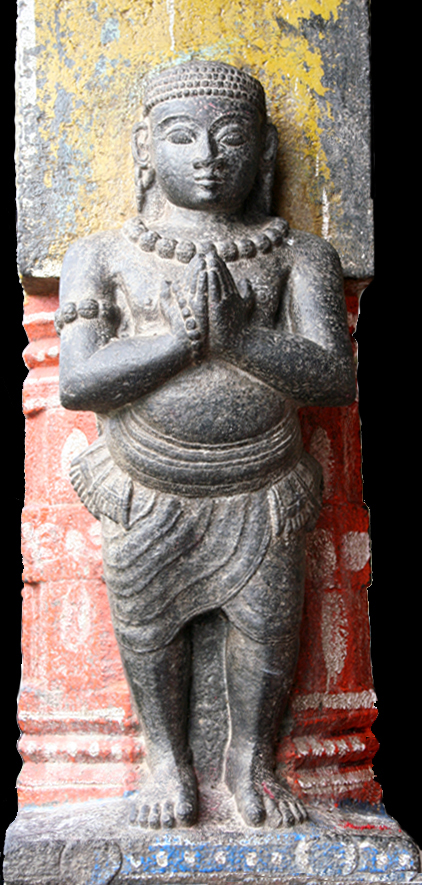
After the postural practice comes the closing chant. Having explored our inner life, we say goodbye to one another, promising to meet again — a way of giving thanks to the masters of Yoga, then reopening to the outer world to share our peace with it, before integrating the class lying on the floor (śavāsana).
svasti-prajā-bhyaḥ pari-pāla-yaṁtāṁ nyāyena mārgeṇa mahīṁ mahīśāḥ |
go-brāhmaṇebhyaḥ śubham-astu nityaṁ lokāḥ samastāḥ sukhino-bhavaṁtu ||
auṁ śāntiḥ śāntiḥ śāntiḥ
Translation (from Jean-Claude Garnier’s French): Om. May all men be protected and live in peace. May those who lead walk the path of justice. May the whole world and the seekers of truth be under divine protection, so that existence may be happy for all. Om — be in peace, go in peace, share the peace.
“Om, the sacred syllable, is all: what was, what is and what will be. Imperishable, it is beyond the three times.”
Māṇḍūkya Upaniṣad
In short
Prārthanā opens the session the way one opens an inner space. Through the chant, the practitioner gradually leaves dispersion and enters the unity of body, breath and mind.