
Keeping a yoga centre’s accounts means recording the value of the operations carried out and knowing precisely what the centre owns and what it owes. Here are the main principles, obligations and invoicing rules.
What is accounting for?
It lists chronologically the money coming in and going out: income and all resources (sale of t-shirts, books…), expenses and all charges — which makes it possible to derive the operating account and then the net result for the year (the income statement). Another annual document, the balance sheet, gives the state of financial balance by listing what the centre owns and what it owes. Supporting documents are added.
The obligation to keep accounts
It is compulsory for any activity, commercial or not — with nuances: simplified accounting exists for the liberal professions (French tax forms 2035A to 2035F, “Non-commercial income”), with exemption from an assets/liabilities balance sheet.
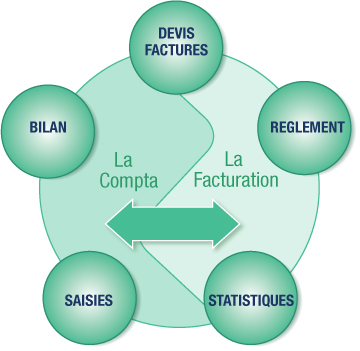
The principle of the chart of accounts
The general principle is “double entry”: each operation is recorded in a two-column table — income (receipts) and expenses (outgoings). Everything is classified by nature, which makes it easy to find an entry.

Account books
Certain account books must be kept up to date depending on the size of the centre. Today, software produces the general-ledger reports: no more need for a paper version. Differences apply for the liberal professions.
Issuing invoices
Any transaction between professionals requires an invoice. The mandatory details:
- your name, address, yoga centre;
- your trade or professional register number;
- the company form where applicable (EURL, SARL, SA…);
- the client’s name and address;
- the invoice number and date;
- the precise description (goods or services);
- the quantity sold;
- the unit price before tax;
- the VAT rate in force and its amount;
- the total including tax;
- the date or payment terms.
Where applicable: discounts, method of payment, late-payment penalties, early-settlement terms. The invoice is issued in two original copies: one for the client, the other to be kept for at least 5 years. It is given immediately for a sale with immediate collection, later for an ongoing service. An invoice is always mandatory towards a professional (proof and VAT recovery). Towards a private individual the conditions are looser: an invoice becomes mandatory if they can recover VAT, buy remotely, request one, or if it concerns an association or a yoga teacher (deduction of expenses).