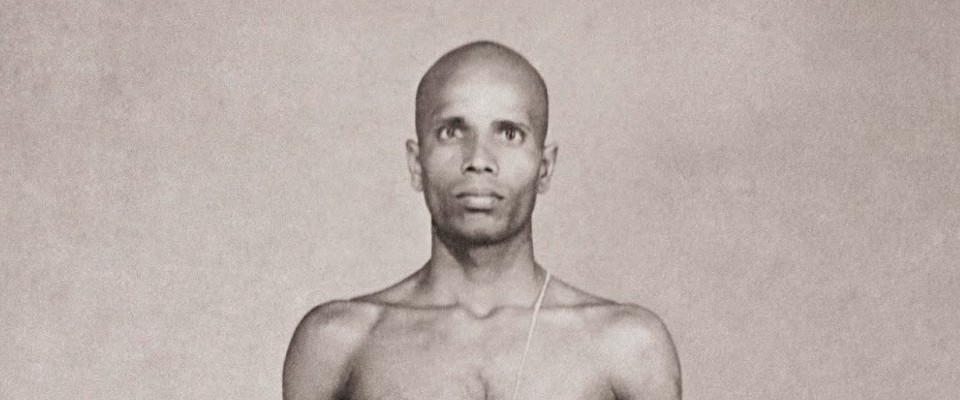
Drishti, the point of gaze, deeply transforms the practice of yoga postures. In Aṣṭāṅga Yoga the eyes remain open, but they do not look at random. The gaze becomes an inner direction, a support for concentration and a path towards greater stability.
In the practice of Aṣṭāṅga Yoga the eyes are open. Just as when driving a car, a motorbike or a bicycle, we look at the road in the direction we are going — otherwise, an accident. The gaze, in Ashtanga Yoga, is the path towards fullness.
“O yogin, do not practise the āsana without dṛṣṭi…”
Vāmana Ṛṣi, Yoga Korunta
Drishti: focusing the gaze
Drishti is the focusing of the gaze on a fixed point. That point gives the posture a direction and limits dispersion. When the gaze wanders, the mind follows the same movement; when the gaze settles, the breath and the body can settle in turn. In Ashtanga Yoga each posture has its own direction: the gaze accompanies the movement, then stabilises. This precision helps to keep the balance and to stay present in the effort.
The benefits of drishti in the āsana practice:
- it develops concentration;
- it improves the direction of the nervous flow;
- it brings movement to the connective tissues (the fascia that envelop the muscles).
An open but undispersed gaze
Drishti is not a straining of the eyes. It is not about fixing hard on a point, but about laying the gaze down. The eyes stay open and available while avoiding getting lost in the surroundings. This quality matters in a practice room: the body may be tempted to look at others, to compare, to correct the outer image of the posture. Drishti brings the attention back to direct experience — the breath, the support, the rhythm, the sensation.
The first śloka of the Yoga Korunta names the nine drishti:
- the tip of the nose — Nāsāgrai;
- between the eyebrows, the third eye — Nāsāgra madhya;
- the navel — Nābhi cakra;
- the hand — Hastagrai;
- the foot — Pādayoragrai;
- far to the right — Pārśva dṛṣṭi;
- far to the left — Pārśva dṛṣṭi;
- the thumbs, hands joined in prayer — Aṅguṣṭha madhya;
- upwards, in the vertical line of the eyes — Ūrdhva dṛṣṭi.
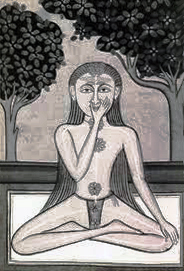
The gaze and meditation in movement
Within the Vinyāsa, the gaze takes part in the continuity. It accompanies the inhale, the exhale and the transitions. As the practice grows steadier, drishti allows the practitioner to enter a form of moving meditation. The gaze becomes a thread: it links the āsana, supports the attention and gives the series a calmer quality. It completes the ujjāyī breath and the bandhas, in the spirit of Tristana.
“The sage holds his visual energy between the eyebrows, with equal length of inhale and exhale flowing through the nostrils; master of his senses, his mind and his intellect, intent on liberation, freed from desire, fear and anger — he is forever free.”
Bhagavad Gītā, V, 27–28
Conclusion
Drishti is simple in appearance yet profound in its effects. By placing the gaze, the practitioner learns to direct the attention and to let the practice become more inward.