This “News Letter” No. 1, was written in October 2012 to Athens – Greece
The heat (tāpas – तपस्), on the road to fullness…
 «Oh yogi, do not practice Yoga without vinyāsa, which lead to tāpas…»
Vāmana Ṛṣi (devanāgarī : वामन ऋषि) Yoga Korunta
In Ashtanga yoga, we give a lot of importance in the internal heat, developed by the Sādhanā (साधना) ” the fire which leads to the sky “, the internal fire, that of the ascetic. Etymologically, it is interesting to remember that one of the origins of the word Yoga, as found in the Véda (s) indicates the one who is related to the fire of sacrifice, the one who sees, because he connects, “yug”, the telluric strengths of earth and the cosmic strength of the sky.
The sacrifice fire : Tāpas तपस्
Etymologically, «tāpas » indicates the heat, the ardor, the internal fire, the action to cook.
The Yogi warms up by the drunkenness of the « vinyāsa » (िन्यास), and it is the “vinyasa” which produces the internal heat by the exercise called Sūrya Namaskar (सूर्य नमस्कार – sun salutation. The term « tāpas » indicates then any ascetic activity because in fact, it is synonymous with control and mastery of the vital energy, called essential energy.
«Tāpas » indicates in RigVéda, creative force exercising on the material and the spiritual. In the famous cosmogonical hymn, it is said that :
” The One originated by the power of the heat ”
Rig Véda ( 10129 )
In Brāhmaṇa(s) (ब्राह्मण -VIIIth century before the J.C.), the Spirit, ” manas “, warms up, ” tapasya “, to create The Cosmic Man, Prajāpati (प्रजापति), who warms up even more in order to multiplie himself.
” From blazing “tapas” were born the order and the Truth “.
RigVéda
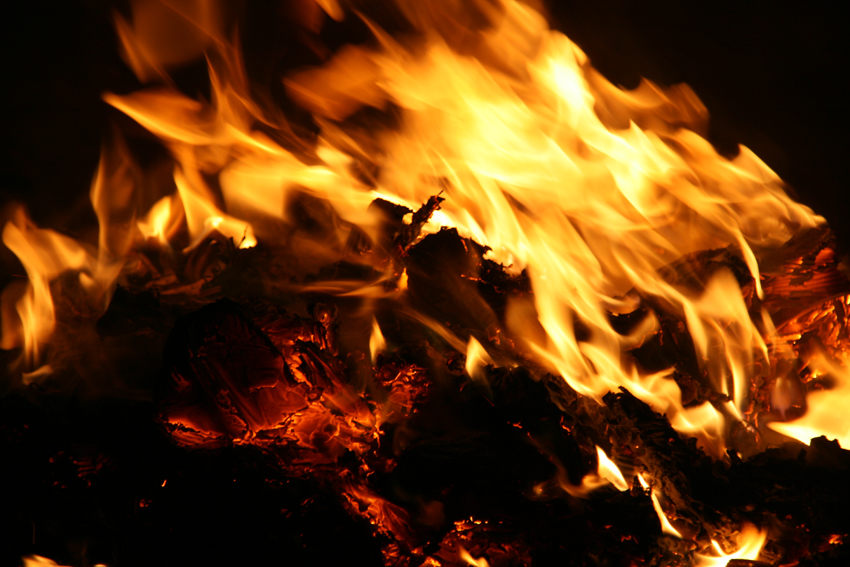
The common point of all these images, it is the notion of heat. In Sanskrit Heat is called « tapas » in the double sense of physical heat and the ardor or ascetic effort.
Tāpas is part of the monastic initiation ritual sannyasa diksha. This ritual of consecration included a meditation in silence with the sacrificial fire, a time of fast, over a period from one day to one year. This Sādhanā (साधना), is practiced in a hut, symbol of the womb, it turns the retreating man, when he comes out of the hut (kutir), into a reborn, regenerated man.
The underlying idea in all this is that the heat is creative. In yoga, the accent is put on will, effort and discipline. There is no possible progress without these fundamental qualities. The effort produces a heat named « tapas » , which means ascetic effort in general.
Some myths illustrate this truth.
“At first the Non-being made himself spirit and warmed up,
giving birth to the smoke, to the light and to the fire,
and finally to Prajapati who created the world by warming up in
an extreme degree by the asceticism which lead to a strong sweating. ”
(Taittiriya Brahmana. II, 2,9,1610)
For Patañjali (पतञ्जलि), author of the Yoga Sūtra, also called Rāja Yoga, yoga is a technique of asceticism, contemplation and concentration with the aim to release the ātman, the self of which man is the prison.
In Bhagavad Gītā (भगवद्गीता), it is a way of obtaining the mystic union.
Yoga is a practice which aims at awakening an internal fire, in order to transform (by cooking tapas) the personality and purifie the conscience.
In certain forms of yoga, one estimates the degree of progression of the yogi on the road of yoga by the intensity of the heat that he develops by the exercise of tapas. In Tibet, Mongolia and Siberia, one estimates the degree of preparation of a disciple according to his capacity to dry, directly on his bare body and in full snow, a big number of sheets ,dipped in water during a winter night. In Tibetan, this internal heat is named gtum-m ö (pronounced: tum-m ö).
If the learning of Ashtanga Yoga is correct, the beginner is going to obtain an intense sweating with his practice.
Om Shanti,
JC Garnier