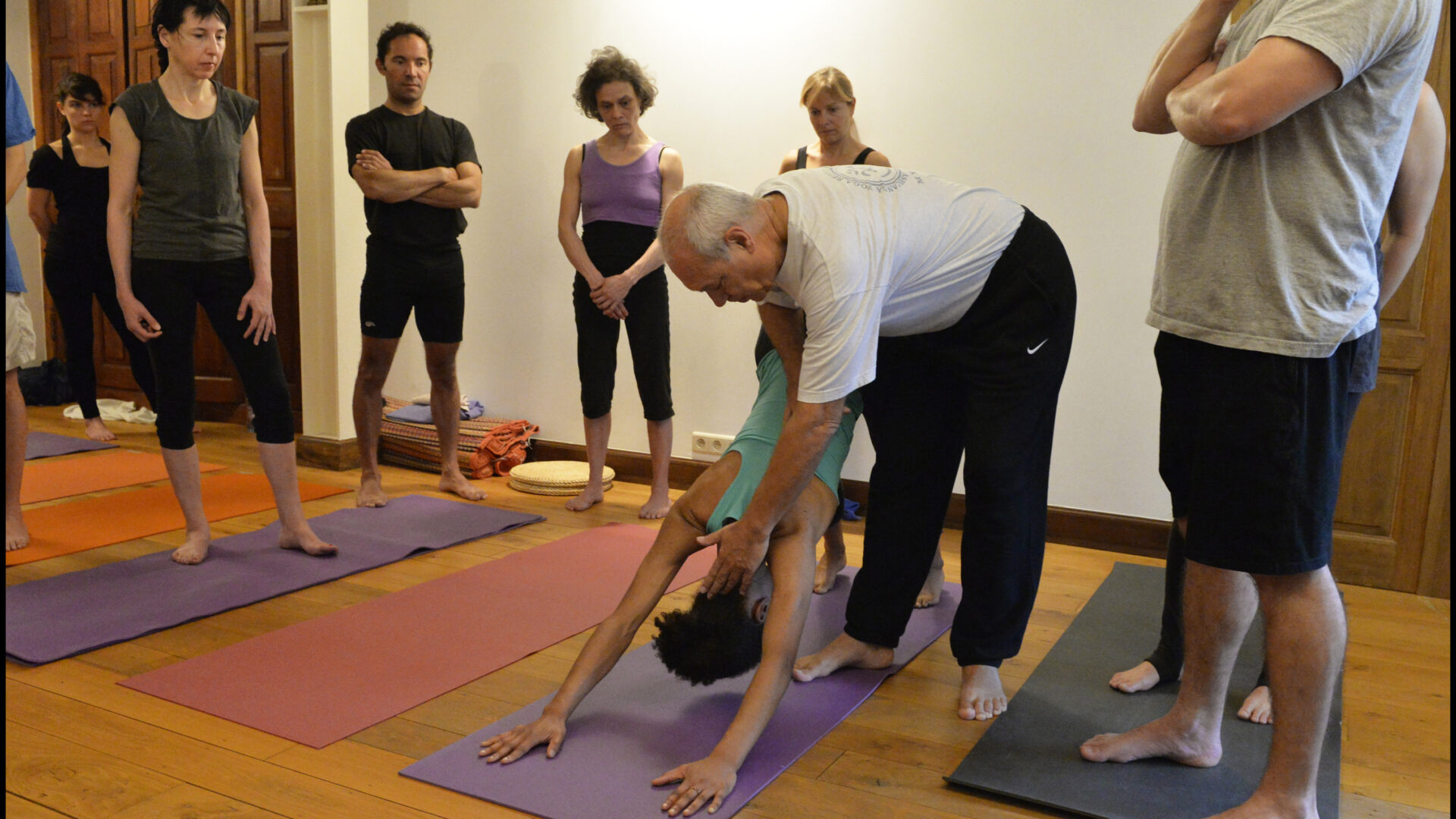
The course runs over three years, in a spiral: you return to the same foundations, each year a little deeper. Here is what is studied, field by field.
Hours and volume
The training amounts to 2,500 hours of formative work over the cycle, on top of personal practical and theoretical work — reading, research, the dissertation — roughly 200 hours a year. At a rhythm of 9 three-day weekends plus one residential week, that is 34 days of training a year, not counting the observation and assisting hours of the final year.
A typical day: three hours of practice in the morning, supervised at times, and one hour of personal research; three hours in the afternoon — questions and answers, detailed study of the postures, breathing, theory and methodology — and one hour of personal research.
The practice
- Learning the First series (Yoga Cikitsā), then the Second (Nāḍī Śodhana) and the Third (Sthira Bhāga), according to each person’s progress.
- The vinyāsa — the linking movements — and their rhythm.
- Ujjāyī breathing, the bandha (Mūla, Uḍḍiyāna, Jālandhara), the dṛṣṭi.
- How fast to progress: the posture adapts to the body, never the other way round.
Anatomy & physiology
- Anatomy and physiology applied to yoga.
- Basic traumatology in relation to practice — protect, never force.
- Movement: reading the body, placement, adjustments.
Hygiene & diet
- Hygiene of the major systems — kriyā, dhauti.
- Diet: eating to practise, practising to eat better.
Sources, history & philosophy
- History of the texts and traditions: śruti, smṛti, darśana.
- History and philosophy of yoga: etymology, the purpose of yoga, methodology, sacred texts — including the study of Patañjali’s Yoga Sūtra.
- Comparative philosophy between East and West: cultures and customs, differences and similarities.
- The great religious currents of India, the great Indian masters and their thought.
Supportive listening
The heart of the teacher’s stance — the nature and purpose of the helping relationship, an introduction to the collaborative relationship and its four components.
- The empathic relationship — empathy.
- The authentic relationship — authenticity.
- The warm relationship — being warm.
- The professional dimension.
- The “little bicycle” technique and the meta position: observing in three directions, self-assessment.
- Transference and counter-transference: regulating and stepping back.
- Practical tools of active listening: communication, levels of listening.
- Transactions and relational games: the notion of stroke and the need for recognition, transactional positions (Parent-Adult-Child), dysfunctional relationships.
- How to offer help — and when.
Psychology
- An introduction to group work.
- An introduction to some fields of psychology — temperaments and characters, sleep and yoga.
- Yoga and modern psychology; elements of psychopathology.
Sanskrit & symbolism
- The āsana, their Sanskrit names and their symbolism.
- Connecting each gesture to its source — the vocabulary is collected in the Institute’s yoga glossary.
Teaching material
For the theory classes, each participant receives a digital study document accompanying the lectures: definitions, diagrams and summaries, so that attention can go to the explanation — without replacing active note-taking.
The teaching given here is faithful to the Yoga Korunta, transmitted by Sri K. Pattabhi Jois at the Ashtanga Yoga Research Institute in Mysore, Karnataka, South India.
How the three years unfold
The fields above are not all studied at once: they unfold over three years, each carried by a single question. Here is the order in which they are approached.
Year 1 — Practising: becoming established in the practice
- Weekend 1 — Entering the path — What is Yoga? · The Darśana · The place of Ashtanga Yoga · Sādhana · Ujjāyī and first notions of Mūlabandha
- Weekend 2 — The body as a support for practice — General anatomy · The spinal axis · Breathing · Foundations of the standing postures · Stability
- Weekend 3 — Breathing — Respiratory physiology · Prāṇa · Ujjāyī in depth · Synchronising breath and movement · Observing the fluctuations of the mind
- Weekend 4 — Bandha and centring — The abdominal cylinder · Deep muscles · Mūlabandha · Stabilisation · Right effort
- Weekend 5 — The Yoga Sūtra I — Atha Yoga · Abhyāsa · Vairāgya · Regularity · Discipline or constraint?
- Weekend 6 — Conscious movement — Vinyāsa · Fluidity · Presence · Attention within movement
- Weekend 7 — Anatomy of movement — Fascia · Muscle chains · Individual adjustments · Listening rather than correcting
- Weekend 8 — Philosophy lived — Yama · Niyama · Application in daily life · Consistency
- Weekend 9 — Synthesis — Bringing the elements together · The complete series · Review of the first year · Direction for what follows
Seven-day residential — Becoming established in the practice. Daily sādhana, silence, breathing, a personal journal and the study of the Yoga Sūtra.
Year 2 — Understanding: giving meaning to the practice
- Weekend 1 — Subtle anatomy — Nāḍī · Chakra · Kośa · Body, breath and energy
- Weekend 2 — The Kleśa — Avidyā · Asmitā · Rāga · Dveṣa · Abhiniveśa
- Weekend 3 — The psychology of Yoga — Ego · Mind · Buddhi · A yogic reading of experience
- Weekend 4 — The relationship — Encounter · Presence · Observation · Intersubjectivity
- Weekend 5 — Active listening — Levels of listening · Quality of presence · Measured speech
- Weekend 6 — The collaborative relationship — Empathy · Authenticity · Warmth · The frame
- Weekend 7 — Transference — Projection · Identification · Dependency · Right distance
- Weekend 8 — Counter-transference — Resonance · Regulation · The meta position
- Weekend 9 — Synthesis — Understanding the practice · Understanding the other · Staying within the frame of yoga
Seven-day residential — The mirror of the relationship. Listening, observation, intensive practice, relational case studies and work in depth.
Year 3 — Transmitting: inhabiting the teacher’s role
- Weekend 1 — What does it mean to teach? — The teacher’s role · The student’s role · Responsibility · The place of the frame
- Weekend 2 — Leading a living practice — Observing the group · Sensing the dynamic · Choosing the right axis · Pedagogical presence
- Weekend 3 — Adjusting — When to step in? · When not to? · Physical adjustment · Verbal and energetic adjustment
- Weekend 4 — The art of demonstration — Showing · Making felt · Giving to see without imposing
- Weekend 5 — Building a frame — Ethics · Limits · Safety · Responsibility
- Weekend 6 — Transactional analysis — Parent-Adult-Child · Psychological games · The need for recognition · Fundamental interactions
- Weekend 7 — Regulating counter-transference — Complex situations · Emotional regulation · Active neutrality
- Weekend 8 — The teacher’s autonomy — Personal style · Faithfulness to the tradition · Responsible freedom
- Weekend 9 — Preparing to transmit — Practical situations · Supervision · The dissertation on transmission
Seven-day residential — The art of transmitting. Leading practices, feedback and supervision, the viva and the crossing of a threshold.
Present throughout the course
Traditions, the culture of India and the study of the great masters — a thread running through all three years, connecting the practice to its roots.
- Yogic traditions and founding texts
- The history, philosophy and culture of India
- The study of the great masters and their teaching
- Sanskrit, chanting and sacred symbols
Dates for the year
Provisional dates — the start of the next intake is yet to be confirmed.
Years 2 and 3 follow the same rhythm — dates are published each spring.
- Ouvert à tous — Ashtanga – Intensive Practice
- Ouvert en auditeur libre — Study
- Réservé à la formation — Study, Transmission, Residential seminar