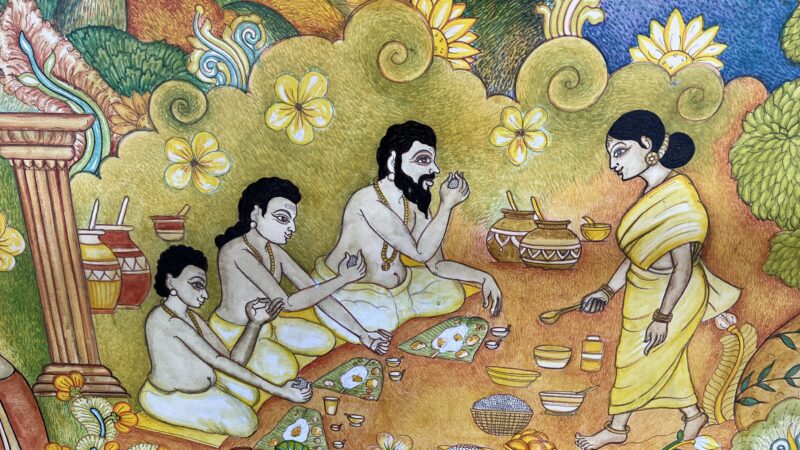
Sattva सत्त्व is one of the three qualities (guṇa) of nature in Sāṃkhya philosophy.
- Sattva सत्त्व is one of the three qualities (guṇa) of nature in Sāṃkhya philosophy. Sattva means: balance, purity, truth, pure consciousness and intelligence, light, inner peace.
- The other two qualities are Rajas (action, passion) and Tamas (inertia, darkness).
- Each guṇa has its emblematic colour: sattva is white, rajas is red, and tamas is black or dark (Lakshmi Kapani, La notion de saṃskāra dans l’Inde brahmanique et bouddhique, Paris, Éd. Collège de France, vol. 2, 1993, p. 416; and Jean Varenne, Dictionnaire de l’hindouisme, Monaco, Éd. du Rocher, 2002, p. 145-157).
How to cultivate Sattva through practice
- Gentle postural practice: prefer flowing, conscious sequences to purely competitive movement.
- Breathing exercises: practise Nāḍī Śodhana, alternate-nostril breathing, to balance the energy channels.
- Ethical discipline: hold to the founding principles, such as non-violence (ahiṃsā) and truth (satya).
- A wholesome setting: practise in a space that is clean, quiet, tidy and aired.
ॐ शान्तिः शान्तिः शान्ति oṃ śāntiḥ śāntiḥ śāntiḥ
In yoga, the threefold repetition of Śānti (Peace) is traditionally offered to keep away the three kinds of suffering, and to bring body, mind and soul towards the state of Sattva.