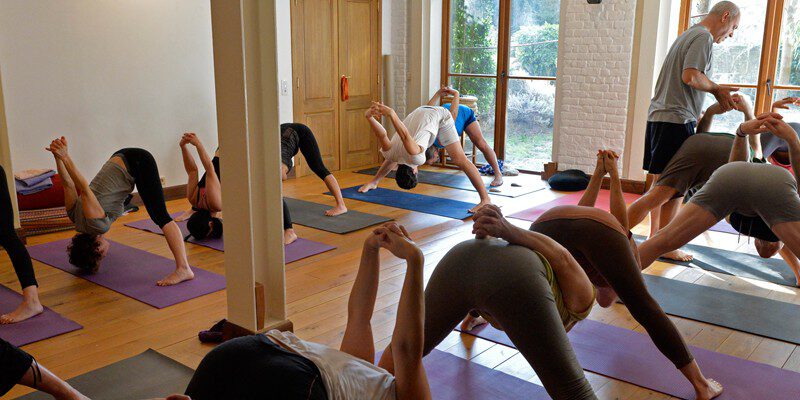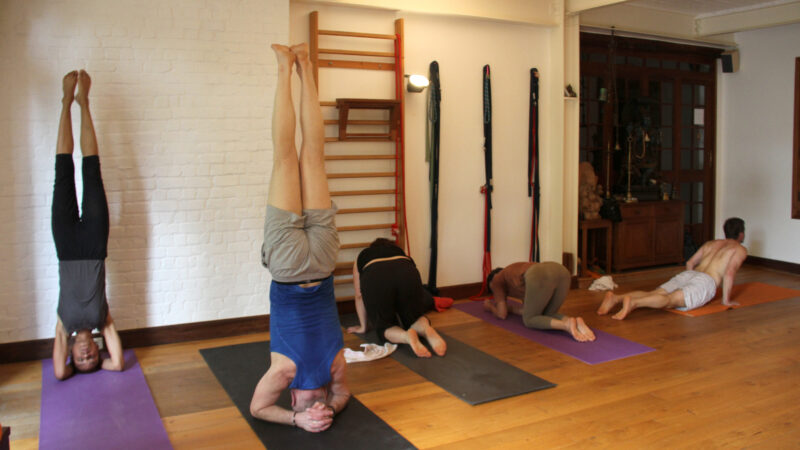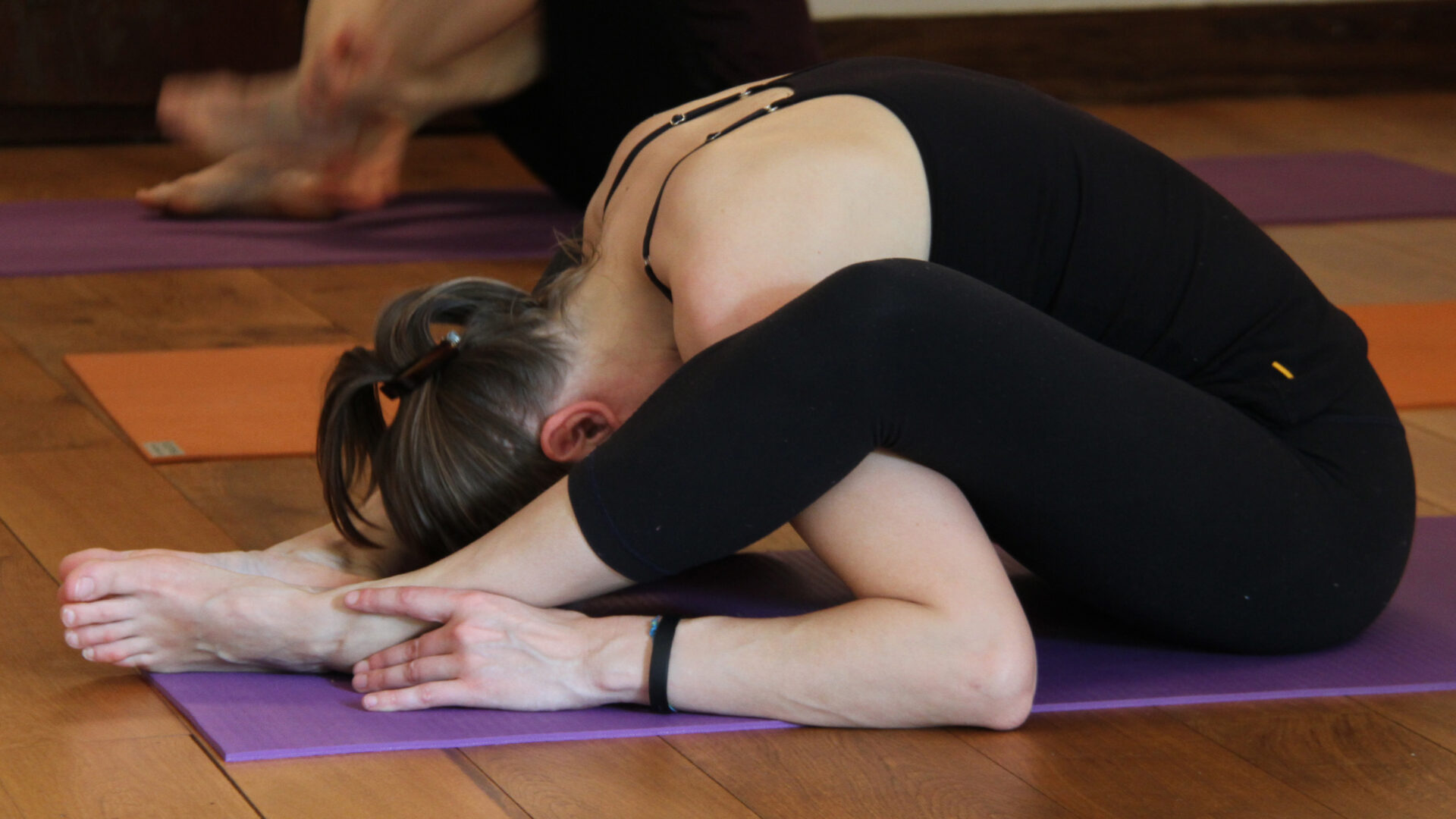
In this introduction to Ashtanga Yoga open-ended course, you will learn specific breathing (Ujjayi Prāṇāyāma), the balance between inspiration and expiration with the sound of your throat.
Inhale, exhale
You breathe through the nose while slowly opening the region of the larynx, which will produce a soft sound. Breathing is a natural and free process but the inspiration and expiration should have the same length.
You will learn the sun salutations (Sūryanamaskāra) that will build up heat (tapas) in your muscles (and in your whole body), you’ll learn how to control your pelvic floor (Mūla Bandha – the pelvic muscles) in order to increase your warmth and protect your body.
The Simplified First Series
This represents the basic foundations of Ashtanga Yoga: here, we will learn 40 of the 70 postures that make up the first series.
“Oh Yogi, do not do asana without vinyasa…”
Vanama Rishi
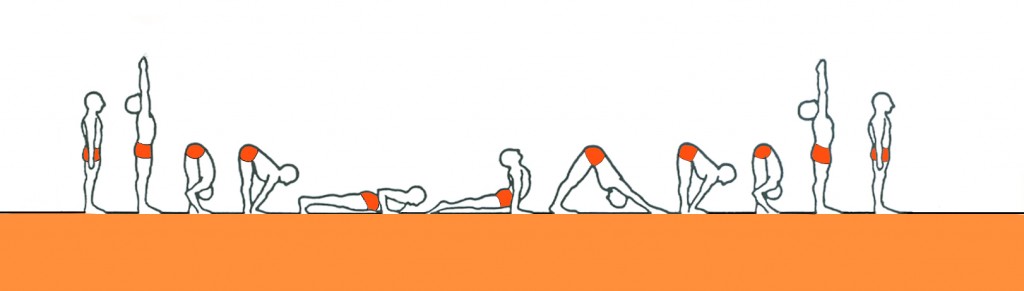
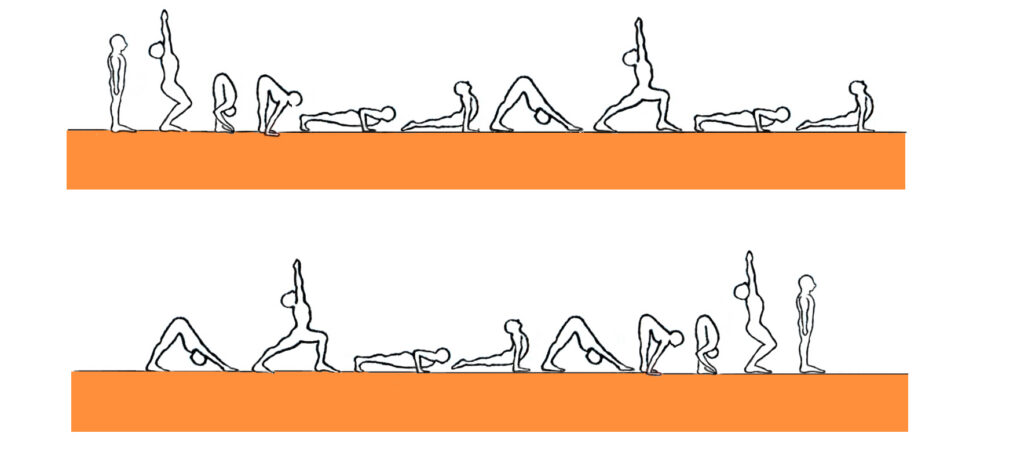
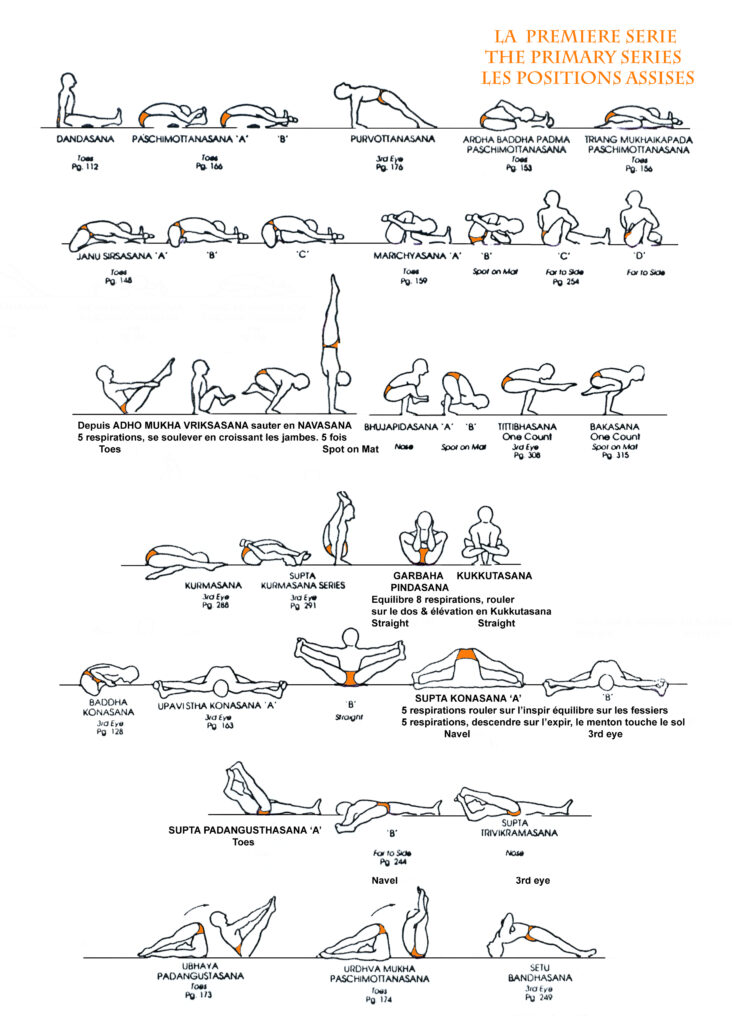
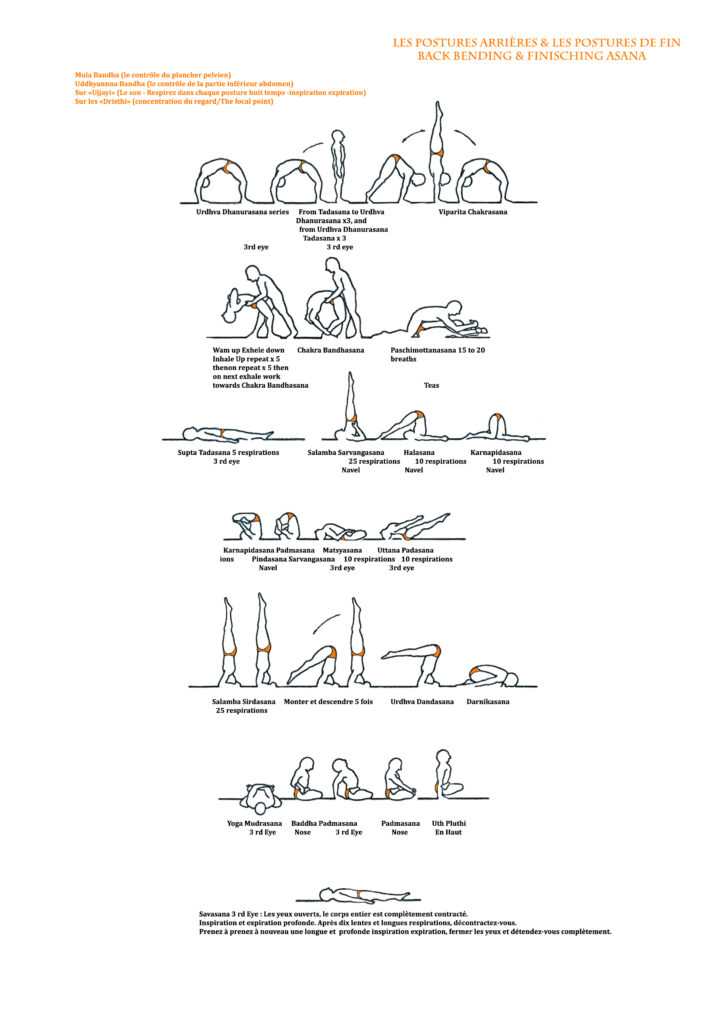
Diagram of postures seen in the class

The postures are also linked together by movements derived from the Sun Salutation (Sūryanamaskāra), which is called Vinyasa.

Vinyasa (the linking movements between postures) generates the heat necessary to cleanse and purify the different bodies (physical, energetic, subtle).

The progressive approach allows you to easily grasp the first series and gives you the confidence to continue.

Depending on your postural and breathing practice (covered in the introductory class), we will integrate the rhythm. As you become more comfortable, you will gradually increase your pace.

At the Ashtanga Yoga Institute of Brussels, we place great importance on the rhythm of a class. The pace is adapted to the level. The tempo of the postural practice will be adjusted to the level of the participants in the class.

This class allows for more individual attention, with detailed instructions and specific adjustments provided by your teacher.

When driving a vehicle, whether it's a car, motorcycle, or bicycle, you look at the road in the direction you're going. Similarly, in the practice of Ashtanga Yoga, the eyes are open and focused in one direction.

Benefits of the practice

Channel your energy through pelvic floor control and abdominal engagement (Mula Bandha)
Develop your concentration by focusing your gaze (drishti) in the postures (asana)
Breathe in harmony with the movement (Ujjayi Pranayama)
Increase your confidence
Connect the postures
Benefits of the practice
- Awareness of your body
- Flexibility of your body and mind
- Rediscovery of the pleasure of breathing
- Development and alignment of your physical, mental and spiritual strength
"By integrating the functions of mind, body, and breath... a practitioner will experience the true joy of yoga practice... Vinyasa Krama yoga strictly adheres to the most comprehensive definition of classical yoga."

Srivatsa Ramaswami
[button href="https://yoga-ashtanga.net/prices-for-the-lessons-at-the-ashtanga-yoga-institute-of-brussels-2014-2015/" style="emboss" size="xlarge" width="532px" title="Courses fees" color="#dd9933" hovercolor="#dd8500"]Prices for the lessons at the Ashtanga Yoga Institute of Brussels[/button]
[button href="https://yoga-ashtanga.net/the-ashtanga-yoga-institute-studio-in-brussels/" style="emboss" size="xlarge" width="532px" title=" Courses location" color="#dd9933" hovercolor="#dd8500"]The Ashtanga Yoga Institute studio in Brussels[/button]
[button href="https://yoga-ashtanga.net/information-about-the-ashtanga-yoga-classes/" style="emboss" size="xlarge" width="532px" title="Practical information" color="#dd9933" hovercolor="#dd8500"]Information about the Ashtanga Yoga classes[/button]
[button href="/jean-claude-garnier/" style="emboss" size="xlarge" width="532px" title="Your teacher" color="#dd9933" hovercolor="#dd8500"]Jean Claude Garnier[/button]
Practical information
When to join this class
-
Lundi 19h30 → 21h00
-
Mardi 12h30 → 14h00
-
Mardi 18h30 → 20h00
- Level
- Beginner
- Duration
- ⏱ 1h30
Nos tarifs
Find all our class and retreat pricing in a single document.
📄 Download pricing (PDF)