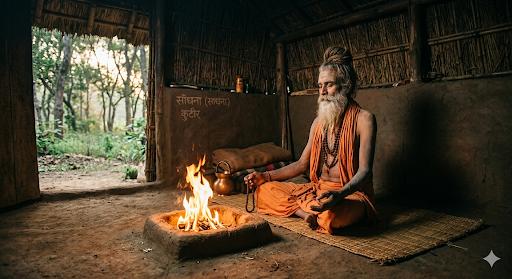
This sequel devoted to Tāpas explores the place of the inner fire on the path of yoga. In Ashtanga Yoga, heat is not only a bodily sensation: it stands for effort, transformation and the ability to cross inertia. It supports the practice as long as it stays tied to the breath and the attention.
The inner heat in Ashtanga Yoga
This News Letter n° 6 was written in December 2012 in Mahābalipuram, India — a continuation of News Letter n° 5.
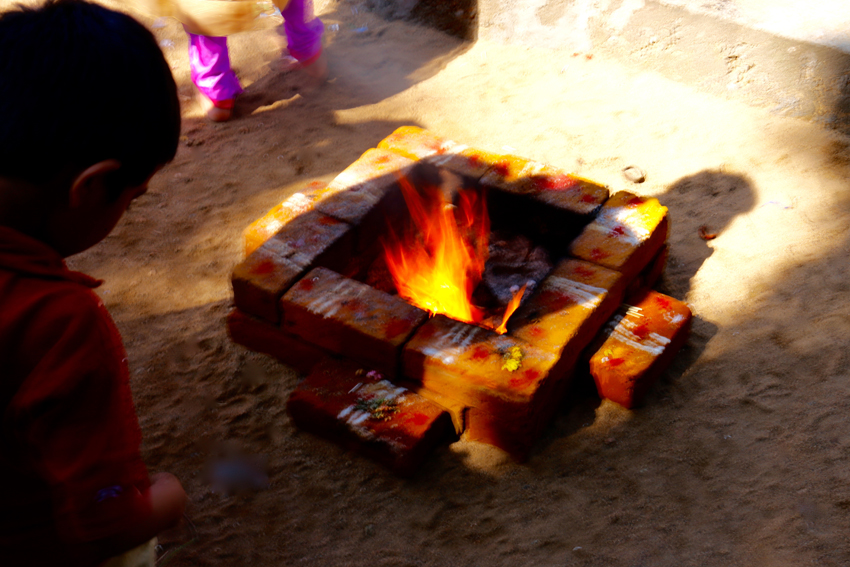
“O yogin, do not practise Yoga without vinyāsa, which produces tāpas…”
Vāmana Ṛṣi, Yoga Korunta
Reminder: in Ashtanga Yoga, great importance is given to the inner heat developed by the Sādhanā — “the fire that leads to the sky”, the inner fire of asceticism. The underlying idea is that heat is creative. Yoga stresses will, effort and discipline; there is no possible progress without these fundamental qualities. The effort produces a heat called “tapas”, meaning ascetic effort in general.
It is not only the elimination of impurities (physical and psychic) that Tapas brings. Heat is also a law of physics: heat rises. In the same way, the “heart” of the yogin (the Ātmā) rises towards the sky thanks to the heat produced by tapas.
The teaching
There is not one single way of transmitting Ashtanga Yoga, but several. Sri K. Pattabhi Jois used the “private class”, the “self-practice” and the “taught class”. Each has its advantages and drawbacks.
- Private class: the progression is individualised and adapted to the person’s real possibilities — bandha, strength, breath/movement synchronisation, integration.
- Self-practice: alone or in a group, the person works their own rhythm, progression and memorised integration. Without the teacher’s attention, the student may lose the rhythm, never meet their difficulties and so never overcome them; working from a written copy of the series, they never truly memorise it.
- Taught class: self-practice and taught class can be compared to an orchestra. In self-practice the musician learns their part and their instrument — individual work. In the taught class, each musician leaves their individuality to merge into the music, into the work itself, in a surpassing of the self.
In the same way, the yogin leaves the ego behind, thanks to the rhythm, to find the “concert”* — that “liturgy” which celebrates the harmony of LIFE, being with the WHOLE. *Concert: from the Latin “certo” (decided, resolute, settled) and the prefix “con” (with, all together).
Om Shanti,
Jean-Claude Garnier