Yoga reminds us that the body is at once a tool, a path, and sometimes a trap when we identify only with its appearance. This News Letter explores the body as a way towards Unity, beyond image, conditioning and the habits of perception.
The body as a path to Unity
This News Letter n° 12 was written in December 2013 in Mahābalipuram, India.
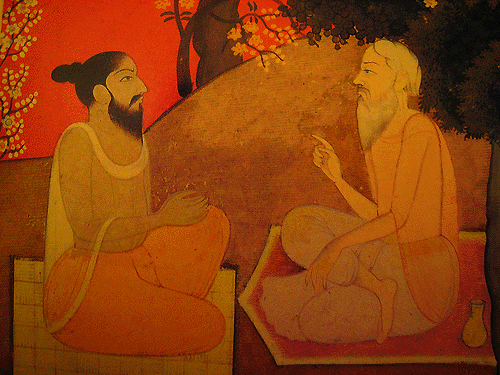
Many problems come from identifying with the body — or at least with its appearance. More and more in our modern age, human beings identify with their body: bodily care is big business (fashion, cosmetics, cosmetic surgery). The individual becomes the reflection in the mirror. Unfortunately, the same happens in a pseudo-practice of Yoga, hence the narcissistic myth of the most perfect, most beautiful posture. But can I reduce myself to the image of my body?
“Am I my body?”
The very word “my” introduces a distance between “me” and the body. Can this body be a “subject”, and hold the status of “I”? In Indian philosophical thought, the subject is the observer, who grasps himself in his wholeness as the origin of his acts.
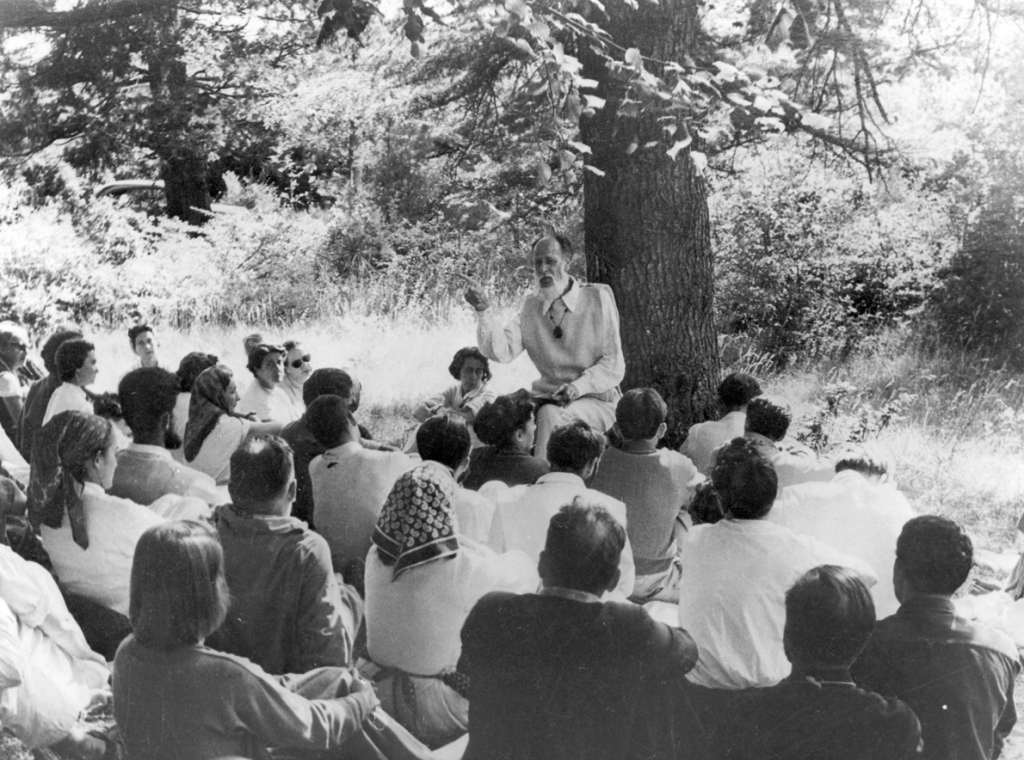
“I am the living UNITY of all the elements that compose me; I am none of the elements that compose me…”
Lanza del Vasto
When I practise yoga postures, my body schema is not the same as when I drive a car. Yet, as that which gives me a consciousness of being, my opening to the world, this body schema also holds a great part of anonymity. Merleau-Ponty defines the body as the “natural self” (what Husserl called the soul), as that through which perception operates. The “I” is present only through the materiality of the body. For C. G. Jung, it is the “inner partner” (anima and animus) that makes us a whole human being.
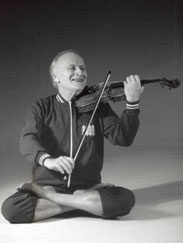
“Just as only a taut string can vibrate, so the stretching of the violinist’s body lets him vibrate — a living structure stretched between the magnets of the sun and the earth.”
Yehudi Menuhin
“As a man embraced by his beloved knows nothing more of ‘I’ and ‘you’, so the self embraced by the all-knowing Self knows nothing more of a ‘myself’ within or a ‘yourself’ without, because of unity.”
Bṛhadāraṇyaka Upaniṣad
Om Shanti,
Jean-Claude Garnier
In short
The body becomes a path when it is no longer reduced to its image. In yoga, it can become again a place of experience, attention and unity.