Yes, you can make a living from your passion — provided you set your prices well and manage your costs. Here are some benchmarks for setting the price of a yoga class.
A self-employed profession
Most yoga teachers are self-employed: you pay your own social contributions (insurance, pension…), with no paid holidays and variable income (10 people one day, 2 the next, sometimes a cancelled class). The minimum hourly rate is around €30–35 per hour, whatever the number of participants. You freely set your prices (group, private, duo, at home), adapting to the rates in your area. A rule of thumb: out of €100 collected, about €40 remains once all costs are deducted.
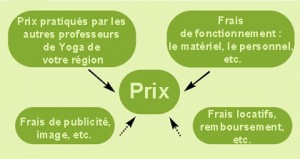
Calculate your running costs carefully: low in a cultural centre (travel), higher in your own space (rent, heating, water, electricity, mats, cleaning…). Good management is essential — and, once organised, it becomes a real space of freedom.
Price benchmarks (group class, 1½ h)
| City (2014) | Trial class | 10 group classes | Mat rental |
|---|---|---|---|
| Paris | €25 | €200 | €2 |
| Brussels | €20 | €130 | free |
| Smaller towns | free or €5 | €100 | free |
(Indicative 2014 rates.)
Salary and travel costs
If you are an employee, a beginning teacher’s salary is generally set from the guaranteed minimum wage (RMMMG in Belgium, SMIC in France), plus about 20%, plus transport costs. Travel costs depend on the means used (public transport — keep your tickets; bike, motorbike or car — purchase, depreciation, maintenance, insurance; and travel time). Mileage-cost tables are accepted by the tax authorities depending on the vehicle.