Monthly Archives: November 2014

Breathing adjusted to the Ashtanga Yoga practice Ujjãyi Prãnãyãma

During the entire practice of the postural « sādhanā » in Ashtanga Yoga, we use a type of breathing called « Ujjãyi prãnãyãma », « the breath of the ocean ». There are many variations of the Ujjãyi.

The breathing (prãnãyãma) is always synchronised to the movements.

For a beginner, the inhalation and exhalation must have the same duration.

For an advanced yogi, the inhalation is a little longer.

The breathing methodology in Ashtanga Yoga :

  1. A continuous and uninterrupted flow
  2. Always breathing through the nose
  3. Opening gently the larynx region (Jālandhara)
  4. It should produce a soft sound (Ujjãyi)

Thereby the breathing sound (Ujjãyi) is obtained via the positioning of the throat (Jālandhara)

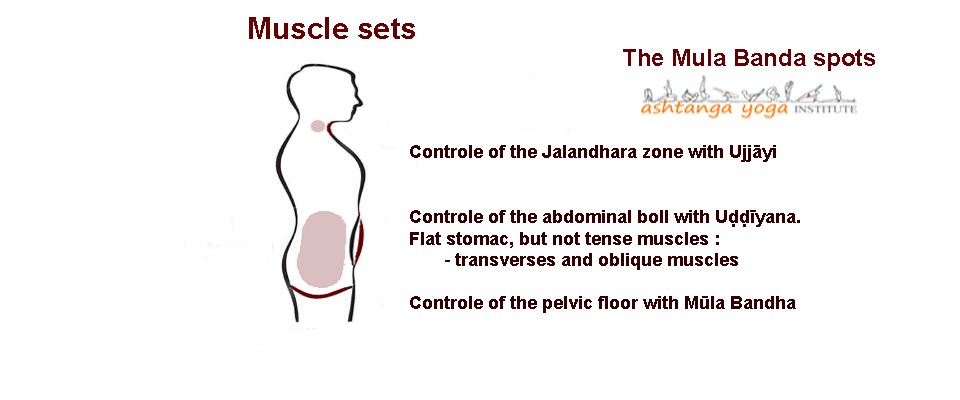
Jālandhara is the glottis control in the ujjāyī type of breathing; it is the positioning of two muscles of the thyroarytenoid laterals, which provokes the characteristic sound of the ujjāyī.

The specificity of the Ujjāyī lies in « control » partial opening of the glottis, in order to control/stop both the air coming in and their going out.
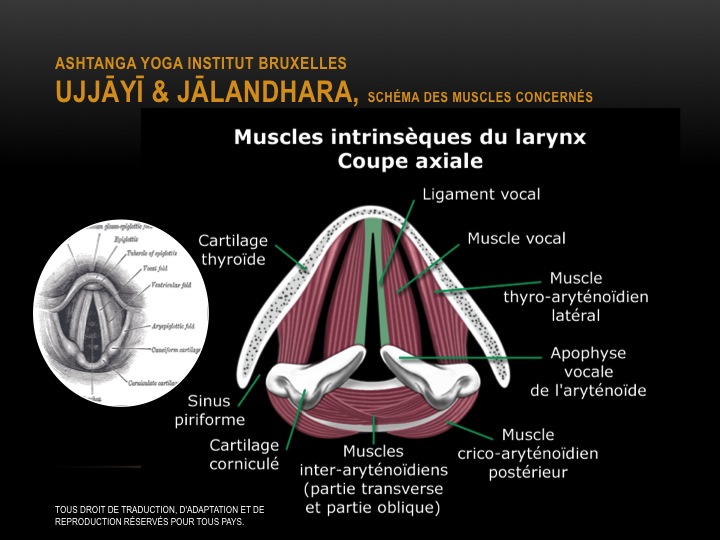
Diapositive94

Nota :

It should not be confused with the uninterrupted breathing (Jālandhara bandha).
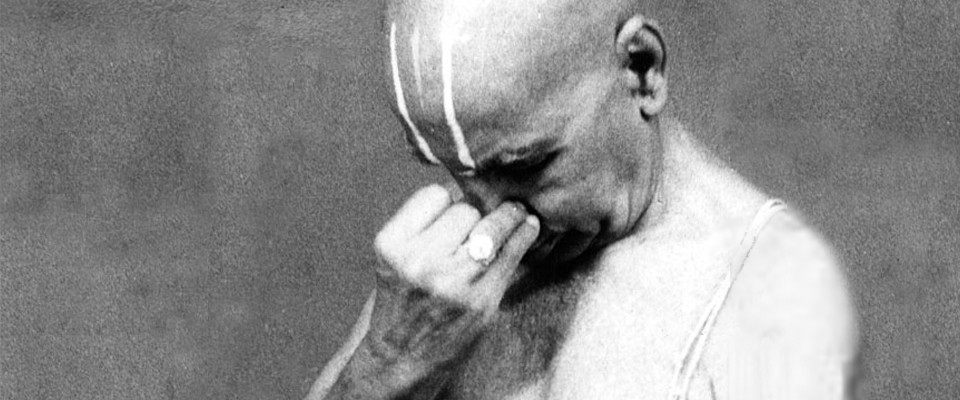
 

Abdominal control, Uḍḍiyāna

In the yoga tradition, there are several muscle positionings (Bandha).

The first control is « Mūla », the pelvic floor, the base.

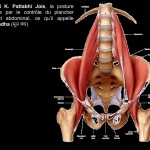
The second control is « Uḍḍiyāna », the abdominal floor .

  1. At the end of the exhale, (when your lungs are completely empty)
  2. Stretch the space between the iliac crests and the ribs
  3. Stretch the transversals, the obliques (inner and outer) and the lower abdominals

Not to be confused with the position « Uḍḍiyāna bandha» that is not a breath, but a stop to the breath.

The best position to learn and deepen uḍḍiyāna & mūla bandha

This ” abdominal control ” can be experienced very easily in the posture « Adho Mukha Svānnāsana » (the dog position with the head down) in sūryanamaskara. This position is held during five deep breaths.

Together « Mūla Bandha & Uḍḍiyāna » represent a safety system that protects the body thanks to its actions on the lower body fascias (reciprocal tension of right and left fascias).

This set participates to controlling the energy in the body (Prāṇa)


Pelvic floor muscle positioning during the practice (Mūla Bandha)

In the Yoga tradition, there are several muscle positionings (Bandha).

The first control is « Mūla », the pelvic floor, the base/foundation.

  1. At the end of the exhale (when your lungs are completely empty)
  2. Lift the anal sphincter, (it is not necessary to contract it)
  3. This positioning will bring the hold/control of the lower abdomen

Whichever the posture, the Mūla bandha produces the necessary energy for a firm postural basis.

Mūla Bandha is held during the entire duration of the postural session.

In itself, It is not really difficult to master the Mūla bandha it is just a matter of attention, concentration and time.

Sri K. Pattabhi Jois considered that 5 years are needed to master it completely.

The second control is « Uḍḍiyāna », the abdominal ball. (See page)

Together « Mūla Bandha & Uḍḍiyāna » represent a safety system that protects the body thanks to its actions on the lower body fascia (reciprocal tension of right and left fascia).

This set participates to controlling the energy in the body (Prāṇa)

It is not sufficient to tighten the anus and to lift this sensation towards the centre of the abdomen, as some wrongly think, for the Mūla Bandha to be present. No, that would be too simple…